
Rethinking Electric Vehicle Adoption Priorities for the Midwest Using a Watts-to-Wheels Comparison
January 20, 2026
A recent study titled “Watts-to-wheel comparison of the air quality, health, and equity impacts of light- vs. heavy-duty vehicle electrification in the U.S. Midwest,” published in Environmental Research: Health, evaluates two electric vehicle adoption strategies across the Midwest. The research compares the societal benefits of electrifying 30% of passenger cars versus 30% of heavy-duty freight trucks.
The study uses a “watts-to-wheel” framework, which captures both upstream increases in electricity generation emissions from electric vehicle charging and downstream reductions in tailpipe exhaust from removing internal combustion engines.
In the Midwest, most of the electricity needed for charging in both scenarios is generated by natural gas and coal-fired plants, with smaller contributions from nuclear and renewable sources. Although electrification increases emissions from electricity generation units, these increases are offset by larger reductions in on-road tailpipe emissions, resulting in an overall net decrease in harmful pollutants.
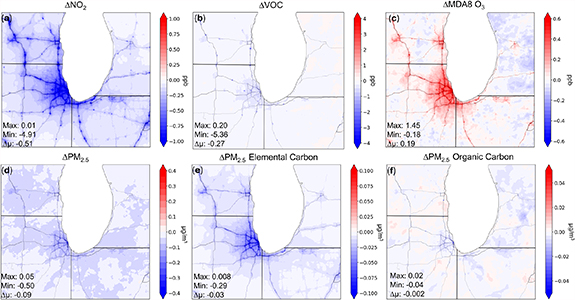
Results show that while electrifying passenger cars leads to larger total greenhouse gas reductions, electrifying heavy-duty trucks delivers far greater improvements in health-harming air pollutants, particularly nitrogen dioxide (NO2) and elemental carbon. These pollutants disproportionately burden communities near industrial corridors, distribution hubs, and major freight highways.
By simulating air pollution at neighborhood-scale resolution, the study finds that heavy-duty truck electrification also produces greater health benefits per vehicle, reducing air pollution–related premature mortality more effectively than passenger car electrification. However, both strategies produce small increases in ozone pollution over urban regions, highlighting the importance of careful policy planning as electrification expands.
“We find that electrification benefits vary across pollutants, locations, and vehicle classes,” says lead author Victoria Lang. “My hope is that this research can support evidence-based policy design within the Midwest, helping states and local governance to tailor electric vehicle adoption incentives so that climate and social benefits align with the needs of specific communities.”
Lang is a Presidential Fellow and Ph.D. candidate in the Department of Earth, Environmental, and Planetary Sciences at Northwestern University, and a member of the Climate Change Research Group, which studies air quality, climate change impacts, extreme weather events, and societal impacts.